Traditional situation analysis begins soon after the shock has occurred. By this time, it is often already too late for humanitarian agencies to understand how market systems operate and how the targeted population accesses basic goods, services, and income.
The Pre-Crisis Market Analysis (PCMA) Guideline was developed in 2015 – by Oxfam and the International Rescue Committee, with support from USAID – to address this problem. A PCMA takes place before emergencies occur, while markets are functioning normally. This early analysis helps practitioners and decision makers understand how markets operate and to anticipate how selected critical markets will behave if and when a shock occurs. This approach is opposite to the one adopted in the post-crisis market assessment tools, where the post-crisis market system is used as the reference point, and then market, trader and household information are used to model how the market operated before the crisis.
PCMA is not a market analysis tool in itself but it helps practitioners to use existing market assessment and analysis tools presented in other toolkits – such as Emergency Market Mapping and Analysis (EMMA), the Rapid Assessments for Markets (RAM), the Market Assessment Guidelines (MAG), the WFP Trader Survey and the 48-hour tool – in pre-emergency contexts.
The PCMA handbook (available in Arabic, Bangla, English, French, and Spanish) is a practical, step-by-step resource to guide market analysis practitioners and team leaders in conducting market assessments before emergencies happen. For someone with practical experience in market assessments, the guidance document should be fairly straightforward to pick up and apply.
Why use PCMA?
PCMA can have a range of objectives, including:
Improving agency preparedness to respond to a forecasted crisis by understanding the impact it will have on the critical market systems
Informing programs seeking to build resilience or mitigate the impact of a predictable crisis
Developing key monitoring indicators.
Providing a baseline of critical markets when they are not under stress (during a non-crisis time or reference period)
Building staff capacity in market analysis and changing approaches and attitudes towards market-based programming
Developing innovative programming and links to longer-term programs
When to use PCMA?
PCMA is used in contexts that are prone to recurring crises, whether natural or man-made. PCMA is particularly suited to contexts where emergencies are reasonably predicted. It can be done in any sector where markets are involved.
Organizing a PCMA assessment is a lot like organizing any type of post-crisis emergency assessment. The biggest difference is that more time and effort will be needed to properly define the scope of the analysis before the full assessment team assembles (for example, you’ll need to decide which crisis will serve as the reference crisis and will need to clearly define the objectives for the assessment).
How long does the PCMA process take?
The length of a PCMA exercise depends on its scope and objectives, and on the market assessment tool that is used. If the EMMA Toolkit forms the basis of the assessment, it is safe to assume that the PCMA will take approximately as long as an EMMA exercise, or roughly 1-3 weeks. If a more rapid assessment tool, like RAM, is used, a PCMA will likely take less time, somewhere in the range of 3-5 days. The assessment leader will need an additional 3-5 days to produce the report.
CASE STUDY
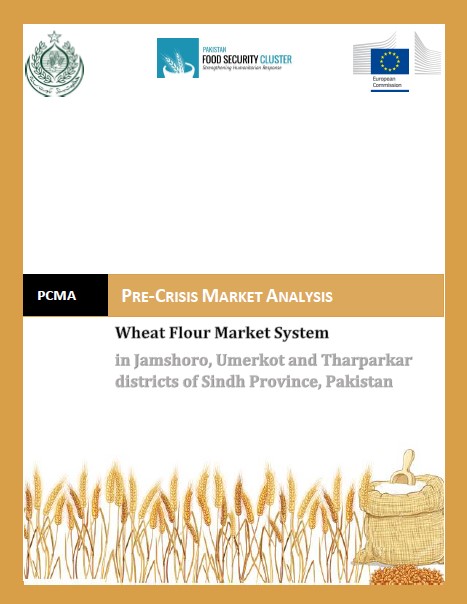
PCMA for wheat flour market in Pakistan
This PCMA, of the wheat flour market in the Jamshoro, Umerkot, and Tharparkar districts of Sindh, Pakistan, was conducted in 2016. The PCMA was premised on a drought emergency scenario for Umerkot and Tharparkar districts and both flood and drought for Jamshoro district. The analysis recommended striking a balance between meeting basic needs in emergency response and mitigation, and longer-term development and resilience efforts.