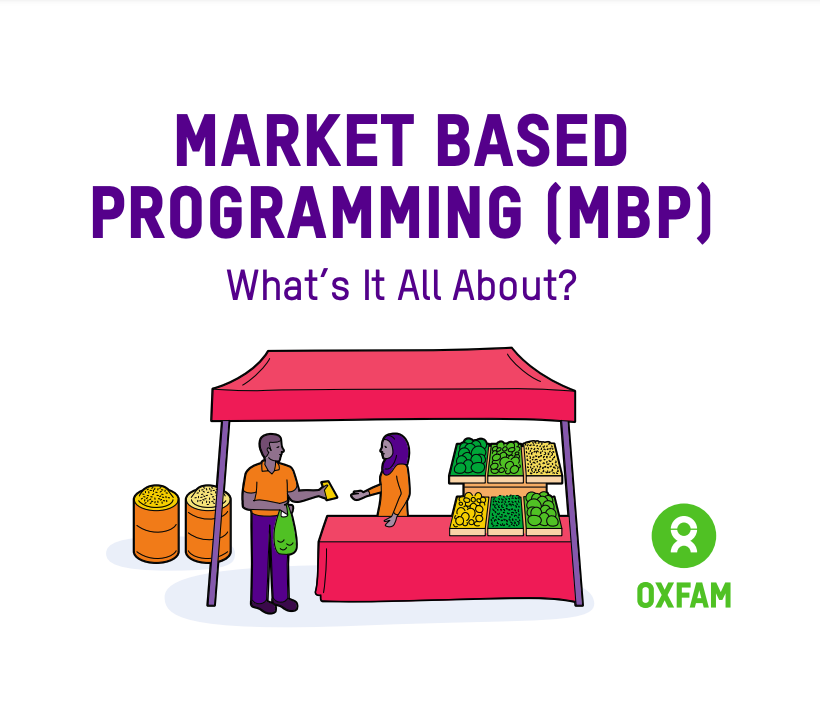
Market-based programming (MBP) refers to any type of humanitarian or development activity that works through or supports local markets. It involves practical interventions that meet immediate humanitarian needs, while also engaging with local businesses and other market actors so as to facilitate economic recovery and ensure lasting impact.
During a crisis, market systems can break down or be temporarily disrupted. This negatively affects the prices, quality, availability and accessibility of vital goods and services for crisis-affected populations. Sometimes markets recover independently. But often disrupted markets need, or would benefit from, extra support to recover faster. MBP acknowledges the importance of preparing, using and supporting local systems to respond, to recover and to build future resilience against crisis.
English
Spanish
MBP covers a broad spectrum of potential activities and responses to crises
Using markets to deliver aid more effectively is about working through existing market systems where they are still functioning, as opposed to creating duplicative humanitarian supply chains that risk undermining these systems. It is an emergency temporary direct response. It includes smart local procurement and market-based modalities for delivering assistance, such as cash and voucher assistance (CVA). The aim is to maintain or improve effectiveness of aid, while avoiding doing harm to local economic systems.
Supporting markets goes a step further by directing assistance to the market actors who provide vital goods and services to a vulnerable population. Recipients (or partners) may be suppliers and traders, wholesalers and retailers, or service providers. The aim is to help them recover, restock, or build capacity faster.
Market system change is a longer-term approach helping vulnerable communities move beyond dependency on humanitarian aid. Programme interventions aim to facilitate early economic recovery and greater resilience by identifying and addressing ‘systemic’ opportunities or constraints on producers, businesses, and employers. These issues may relate to policies and regulations, to prevailing social norms and attitudes, to public infrastructure or to the availability of supporting services.
The MBP framework
MiC’s Market-Based Programming Framework illustrates the whole range of market-based programming in a simple schematic.

Markets work by matching supply and demand. Where supply and/or demand are disrupted in an emergency situation, MBP may address one or both sides:
- Using markets to temporarily boost demand
(e.g. local procurement, cash & vouchers) - Supporting markets to strengthen supply
(e.g. capacity-building, restocking, refinancing)
Market-based programming can also extend beyond immediate humanitarian assistance and seek to rebuild more effective, more equitable and more resilient economic systems for the longer term. To achieve this kind of market system change it is crucial to understand the supporting functions that enable production and transactions in the market system. For example, every primary market system (e.g. a staple food crop) relies on markets for transportation, communications, financial services, power (fuel, electricity), and tools and equipment.
Similarly, all market actors operate within an institutional environment and rules and norms (regulations, standards, and codes of practice, often informal) that govern how goods are produced, accessed, and exchanged. Programs that aim to promote enduring market system change may therefore need to influence this business environment.
Market systems development
Market systems development (MSD) is a medium- to long-term approach to understanding and intervening in markets so that they work better for people living in poverty. The approach (also known as Making Markets Work for the Poor – M4P) aims to support lasting change, by addressing the root causes of market exclusion and weak performance in the economic systems upon which poor people rely.
The Operational Guide for MSD breaks the market systems development approach down into five elements:
Strategy – selecting market systems and setting the focus
Diagnosis – understanding the root causes of problems
Vision – defining the realistic ambition of the program / exit strategy
Intervention – designing and delivering activities
Measurement – monitoring, evaluating, and learning from the results
Minimum Economic Recovery Standards
The Minimum Economic Recovery Standards (MERS) are the internationally recognised consensus on best practices for building economic resilience for crisis-affected communities. MERS draws from the accumulated experience of the world’s leading humanitarian agencies and economic development practitioners, and includes a set of six standards:
Core standards
Assessment and analysis standards
Enterprise development
Asset distribution
Financial services
Employment