

What do we mean by ‘markets?’
A market is a network of buyers, sellers, and other actors that come together to trade any given product or service. Markets exist in agriculture, health, transportation, water and sanitation, energy, communications, education, food, employment, and many other sectors.
Markets include people, businesses, governments, infrastructure, laws, norms and a broad range of supporting products, services, and institutions.

Why should we work with markets in humanitarian contexts?
Traditional aid often overlooks markets, delivering assistance directly to affected populations instead. Bypassing markets – and ignoring how crisis-affected populations cover their basic needs – undermines local suppliers and, ultimately, the recovery and resilience of affected communities.
There is growing consensus in the humanitarian sector on the need to be market sensitive – aware of local economies and local markets. Market data can offer a more holistic understanding of crisis-affected people, their needs, and capacities.
What is market-based programming?
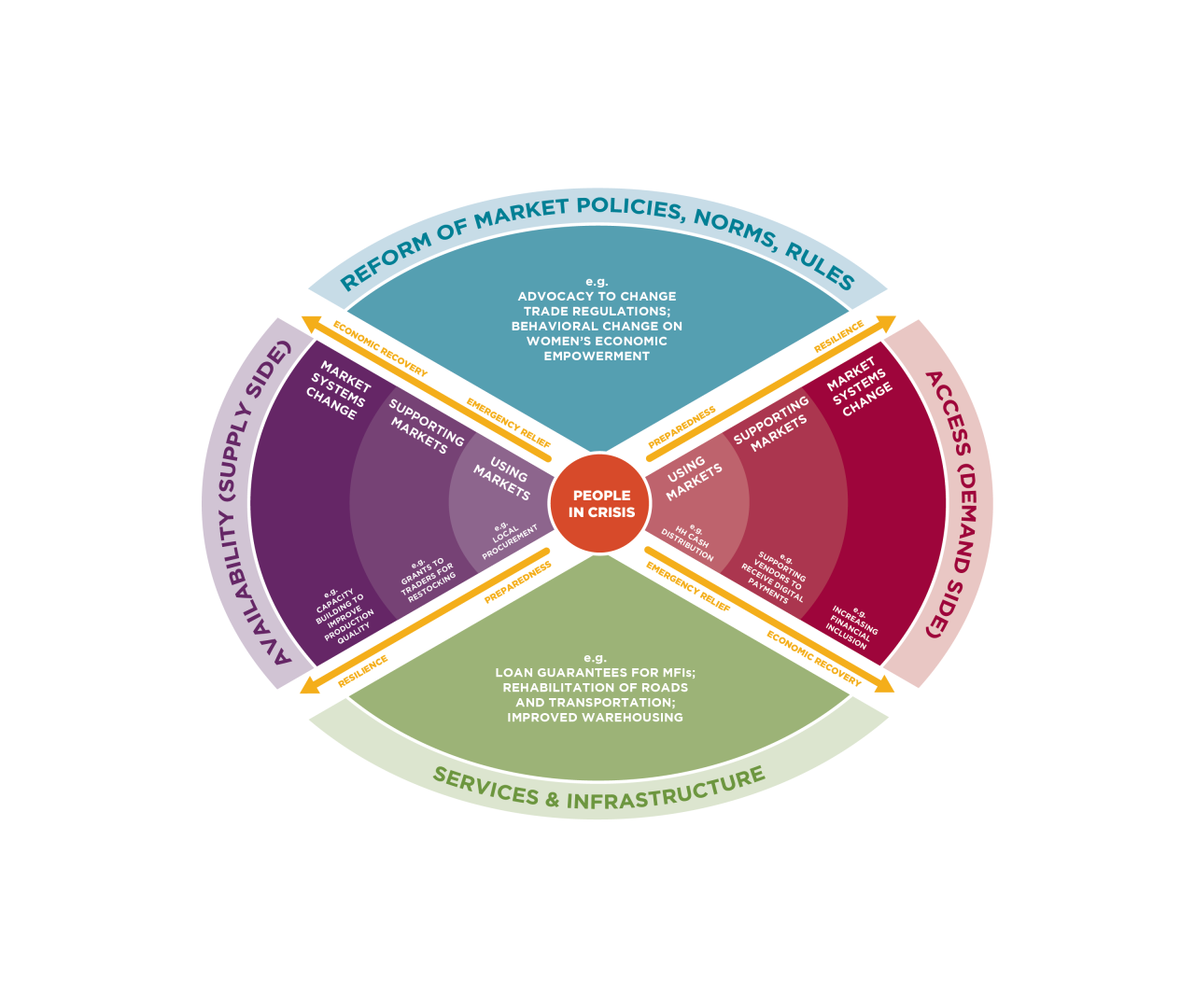
Market-based programming (MBP) is a broad term referring to any type of humanitarian or development program that works through local markets to deliver emergency relief, support post-crisis recovery, or strengthen local economies.
Market-based interventions target specific market actors, services, policies, and infrastructure. In emergency contexts, activities may include: grants to traders to restock; cash and voucher assistance to support affected households to purchase essential goods and services; subsidies to support the supply chains of essential food items; skills development for labor market re-integration; advocacy to government actors to repair key transport routes; and investments in improved access to financial services, protection systems, and communications.
Is it the same thing as cash-based programming?
Cash transfers are a means of delivering market-based assistance, by supporting demand (e.g., an agency delivers cash or vouchers to beneficiaries, who in turn purchase what they need in local markets) and/or supply (e.g. an agency provides cash to traders to restock their businesses with items that are in high demand).
The basic components
The three core components of market support interventions are market assessment, market-based programming and market monitoring. Our brief guidance notes explore the main concepts, approaches and key tools in each component of the intervention cycle.
A market assessment is the collection and analysis of information about key market systems, marketplaces, and supply chains, to better understand their functionality and accessibility to all groups. An essential component of any situational analysis, market assessments seek to determine whether humanitarian and development programs should work through local markets, and if so, how.
Market-based programming refers to a broad range of activities that aim to improve the situation of crisis-affected populations by providing support to critical market systems on which the target population relies for goods, services, labor, or income. These interventions target specific market actors, services, policies and infrastructure.
Market monitoring is the process of regularly collecting information from markets to inform programmatic decision-making. It is crucial not only for targeted market-based programming but for any humanitarian or development intervention with the potential to affect local market actors and prices. This includes, for example, cash and voucher assistance (CVA), in-kind distributions that risk distorting local markets, and any program involving local procurement.

But what I really care about is….
Whether you are interested in food security, health, water, shelter, protection, education, or decent work, markets matter. Our brief guidance notes explore the relevance, approaches, and tools for market-based programming across key sectors.
Where can I learn more?
Start with MiC’s Frequently Asked Questions
This resource aims to centralise answers to the most frequently asked questions and to lay the foundations of commonly agreed concepts.
Ask the community
Join MiC and get access to a unique peer support network. If you’re looking for something, there is a good chance that there is someone in the network that can help!
Resources
The sector’s largest library of resources on market assessment, market-based programming, and market monitoring in emergencies.
Training
Our curated learning center includes short videos, self-paced courses, online and in-person training, and academic programs.
Events
Explore learning and networking opportunities in our events calendar.
Get involved
We are your learning partner. If you are generating, consolidating, or disseminating evidence on market-based programming in emergencies, let us know.